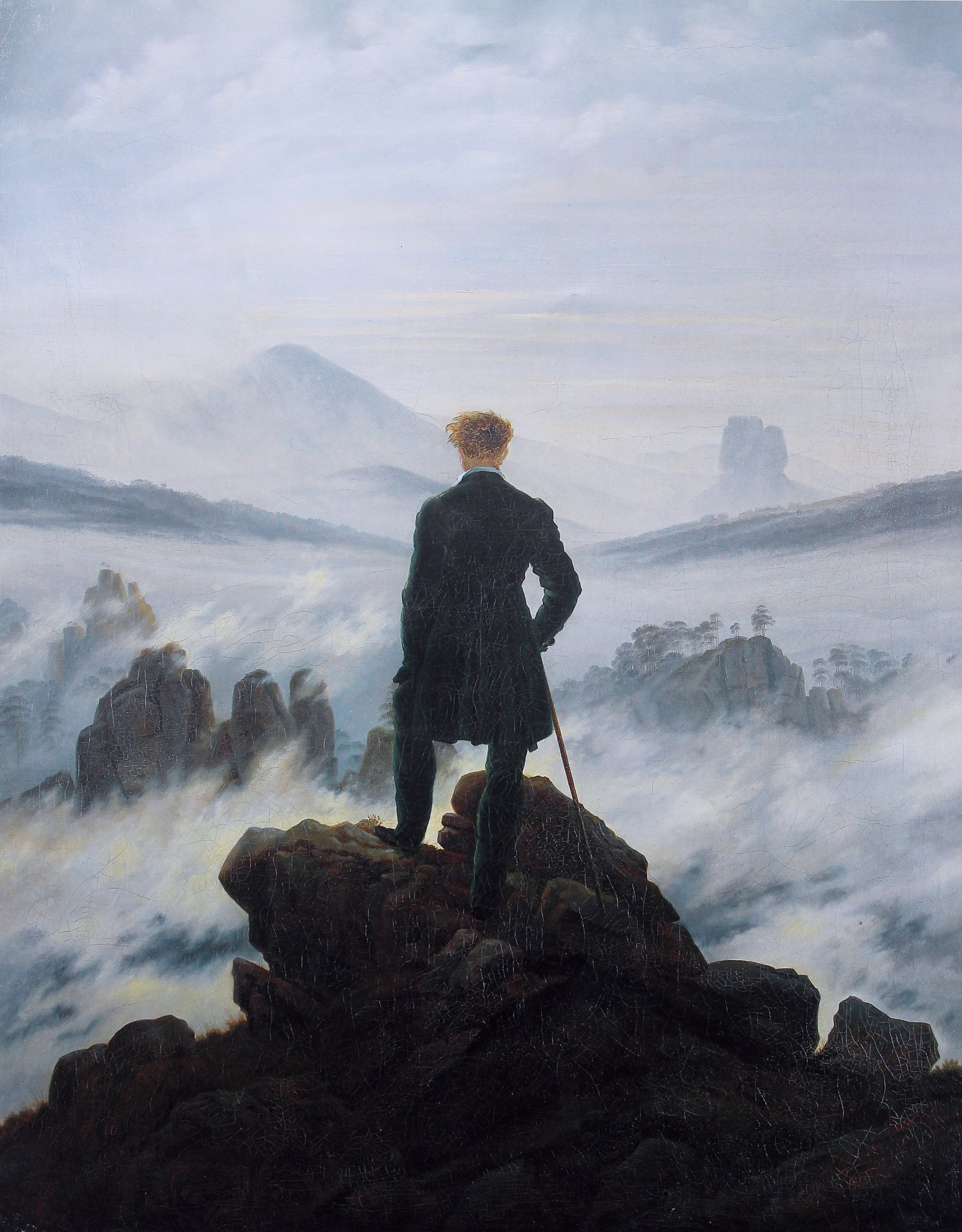
Friedrich, Caspar David, 1774-1840. Traveller Looking Over the Sea of Fog, Wanderer Above the Sea of Mist, Wanderer Above the Mists. c.1818.
Ah yes, there’s nothing better then the feeling that you’ve joined the club.
My friend, who is an English grad student here, hosted a Halloween party last month where the theme was to come dressed up as your favorite author. I’m sure to bet anything that there were a couple of Hemingways running around. Until now, I’ve only heard the name of the American writer, Ernest Hemingway, but wasn’t at all familiar with his works, writing style, or significance in American literature. And now I have this self-satisfied little smug grin that says, “why yes I’m cultured, I’ve read Ernest Hemingway after all.”
But why Ernest Hemingway?
From the quick skim through of his Wikipedia page, Hemingway is considered one of the essential American authors. His work has heavily influenced American literature. It may also help that he lead an adventurous lifestyle, fighting in wars, living across the globe in exotic locations, encountering lots of romantic drama, and ending his life tragically. Needless to say, the man behind the pen was pretty interesting.
I’m also intrigued by some of the elements we see appearing in American literature, and I want to make the case that nature is a big one. All of the assigned readings were noticeably impacted by nature, probably with Big Two-Hearted River featuring it the most. It was while reading Big Two-Hearted River I suddenly got flashbacks of reading Jack London and Gary Paulsen. Much like these two other authors, there is this total solitary immersion into nature. While the writers acknowledge that nature can be unpredictable and unforgiving, the characters that interact in this solitary manner with nature are able to conquer it. There is such pleasure and enjoyment in these narratives. I was a little blown away that there was not one, but two parts of a short story that revolve around a guy going on a little overnight wilderness fly fishing trip by himself. The character Nick, is enjoying himself immensely, and as the reader, yeah I got to feel a part of that enjoyment. Perhaps this feature in American literature such as Hemingway’s echoes back to manifest destiny, this pure American concept of the feeling of duty and purpose to tame and conquer the godless land? I felt a sense of this definitely in Big Two-Hearted River, but in Indian Camp as well. This is completely a primitive theory, but now I’m wondering if manifest destiny is a key feature of classic American literature.
